.svg)


Writer's Studio






After recently publishing his 5th book of poetry, a retired Wall Street executive (and lifelong poet) decided to commit to his passion for writing full-time.
Inspired by a childhood dream of Thoreau’s Walden Pond, he wanted to create a small and simple yet modern studio in which to write, reflect, and enjoy nature.
To bring his vision to life, the poet called upon architect Eric J. Smith, an ardent classicist with a modern point of view. It was decided that the Writer’s Studio was to be self-sufficient and secluded, located deep within a heavily wooded property in Connecticut and accessible by foot. Yet despite being seemingly off the grid, it also needed to be equipped to climatically preserve the client’s rare, 1,700-volume collection of poetry.
The Writer’s Studio succeeds in “being of the place and of the person.” Thirty-inch thick fieldstone walls, which echo the ruins of an abandoned spring house, have been repurposed with steel and glass, creating an openable and transparent enclosure—a cantilevering counterpoint suspended in the breeze.
Once inside, the initial space compresses, the ceiling is low, and exterior fieldstone becomes interior. Planks of fumed white oak form the floors, ceilings, and millwork built-ins. Oak shelves filled with the client’s 1,700-volume poetry collection line the passageway, preserved by a geothermal heating and cooling system. Under one of the shelves, a wooden drawer conceals a trundle bed designed to accommodate the occasional overnight stay. To the left, a staircase ascends through a motorized roof hatch, leading to the panoramic roof deck.
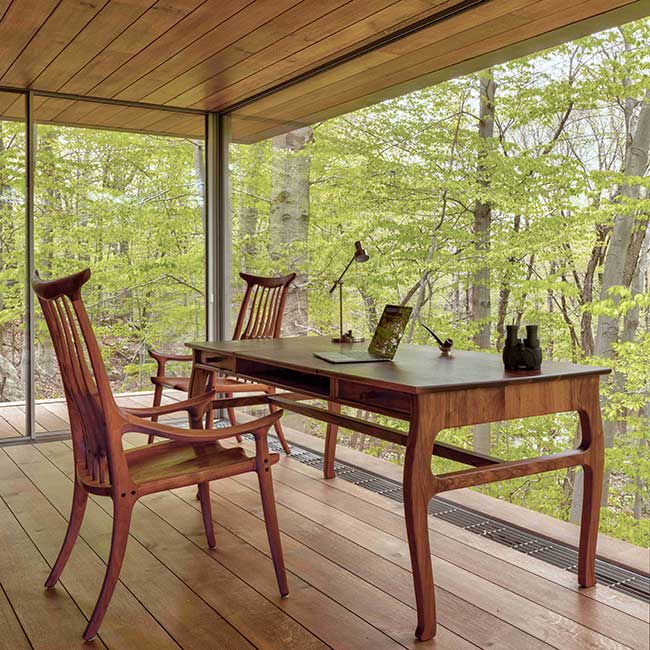
The shelves of poetry lead to a glass writing room, cantilevered high above a ravine. With apparent simplicity, this tiny building belies its complexity. Crafted with Eric’s exacting eye, every edge, corner, and surface of the Writer’s Studio has been carefully considered.